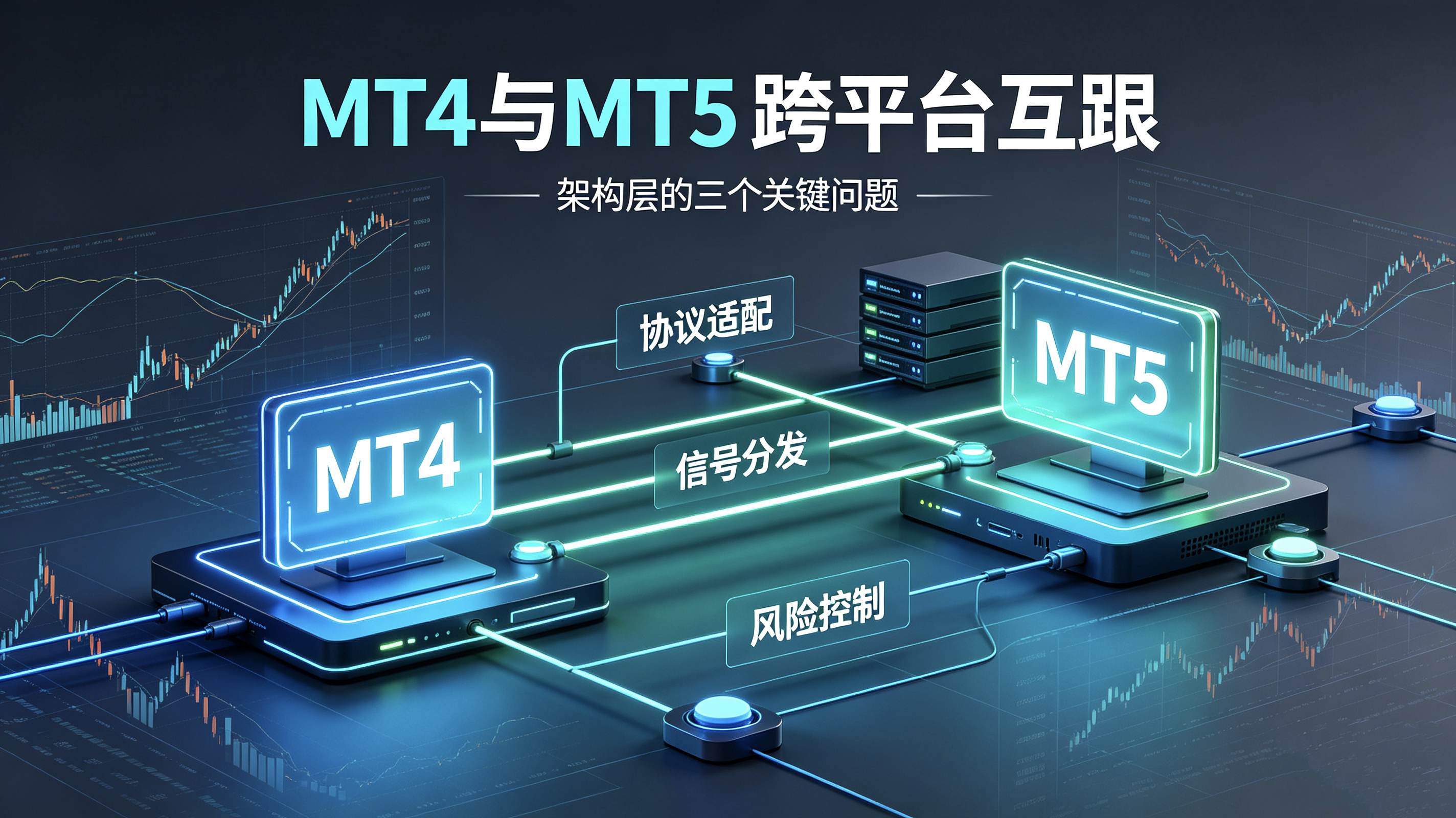
First, Clarify the Concept: What Exactly Is Being Copied
At its core, Copy Trading is simple: replicate the trading actions of a master account (signal source) to follower accounts at an agreed ratio. What really determines the experience is not the act of “copying” itself, but the path the signal takes after the master account is filled, how long it takes, and at what price it reaches the follower account.
API Copy Trading software: The Copy Trading system is deployed on a cloud server. It reads master account orders through a broker’s or trading platform’s API or bridge gateway, performs lot-size conversion and distribution on the server, and finally places orders through the interface or terminal of the platform where the follower account is held.
Local EA Copy Trading: A “signal-side EA” is loaded into the MT4/MT5 terminal running the master account. It writes orders to a local file, shared memory, or LAN socket; a “receiving EA” on the same machine (or the same intranet or VPS) reads these signals and places orders in its own terminal.
In one sentence: API Copy Trading is platform-level, centralized, and cross-terminal; local EA Copy Trading is terminal-level, point-to-point, and locally executed.
Breaking Down the Signal Path: How an Order Reaches the Follower Account
Once you lay out the path, the differences become very clear:
- API Copy Trading: Master account filled → broker or platform push (API, WebSocket, or bridge) → Copy Trading server matches strategy and ratio → distributes to each follower account → execution on the platform where the follower account is held.
- Local EA Copy Trading: Master account filled → signal-side EA writes the order (file, memory, socket) → local or intranet transmission → receiving EA reads it → execution in the same terminal or a terminal on the same machine.

The shorter the path, the lower the theoretical latency; the more standardized the path, the stronger the scalability and cross-platform capability. These two factors often constrain each other.
Comparison of Core Differences
| Dimension | API Copy Trading Software | Local EA Copy Trading |
|---|---|---|
| Signal transmission | Cloud API or bridge gateway | Local files, shared memory, LAN |
| Latency sources | Network round trip, API rate limits, server region | Almost no network latency on the same machine; cross-VPS depends on the connection |
| Cross-platform capability | Strong; can connect to multiple brokers and MT4/MT5 | Weak; usually tied to the same terminal and the same broker |
| Account scale | Dozens to thousands of accounts, centrally managed | Limited by single-machine resources; suitable for small to medium scale |
| Risk control | Centralized parameters, statistical reports, circuit breakers | Depends on EA parameters and local logs |
| Operations and maintenance | Managed and upgraded by the service provider | Self-maintained terminals, EA versions, and licensing |
| Cost structure | Subscription fee or per-account billing | Software license plus VPS cost |
| Strategy confidentiality | Signals pass through a third-party server | Fully self-controlled and not exposed externally |
Latency and Slippage: Which Is More Stable
Latency is not a single number; it is the sum of three stages: signal generation, transmission, and execution. The advantage of API Copy Trading lies in standardization: every segment of the path has clear interfaces and timeout controls, making problems easy to locate. The downside is a longer path; across regions, network round trips amplify latency, and API rate limits can cause queuing during volatile markets.
Local EA Copy Trading’s advantage is physical distance: when the master account and follower account are on the same VPS, signals barely traverse the public internet, so latency can be very low. The downside is that once you cross machines or data centers, stability depends entirely on connection quality, and exceptions in local files or sockets are often harder to troubleshoot than API errors.
It is important to emphasize: neither can eliminate execution slippage on the platform side. The real difference is “the certainty that a signal reaches the execution end”—API Copy Trading is more observable, while local EA Copy Trading is shorter but more environment-dependent.
Risk Control and Money Management
The place where Copy Trading systems most often fail is not the signal, but the ratio and drawdown. Whichever solution you choose, it is advisable to configure at least the following:
- Lot-size ratio: Convert by equity or a fixed multiplier to avoid overloading follower accounts when the master account adds positions.
- Per-trade and total position limits: Cap maximum lots and maximum simultaneous positions to prevent abnormal signals from amplifying risk.
- Drawdown circuit breaker: Automatically stop Copy Trading when equity drawdown exceeds a threshold, instead of continuing to replicate losses proportionally.
- Symbol and direction whitelist: Block unfamiliar symbols and, when necessary, allow only one-way Copy Trading.
API Copy Trading software usually places these parameters in a centralized back office, with statistical reports and alerts; local EA Copy Trading requires setting them item by item in EA parameters and checking logs yourself. The former is quicker to get started with; the latter offers greater controllability.
Cost, Operations, and Compliance
Costs fall into explicit and implicit parts. Explicit costs are the subscription fee or per-account billing for API Copy Trading, or the license fee plus VPS rent for local EA Copy Trading; implicit costs are the adaptation work caused by troubleshooting disconnections, version upgrades, and changes to platform rules.
On operations, API Copy Trading leaves servers, upgrades, and some risk controls to the service provider, so the team only needs to manage strategies and accounts; local EA Copy Trading requires maintaining the terminal runtime environment, EA versions, license binding, and VPS stability yourself. If the team has no dedicated operations staff, this workload is often underestimated.
On compliance, first confirm the platform’s rules on Copy Trading, EAs, and multi-account login to avoid account restrictions caused by violations. Whichever solution you choose, keep complete order and parameter logs for post-trade review.
How to Choose: Four Typical Scenarios
- Multi-account, multi-broker, team-based operations: Choose API Copy Trading; centralized management, unified risk control, and reporting are less burdensome.
- Pursuing extremely low latency and requiring strategy confidentiality: Choose local EA Copy Trading; place the master account and follower accounts on the same VPS or the same intranet.
- No technical operations staff and need visual statistics: Choose API Copy Trading and leave operations to the service provider.
- Already have a mature MT4/MT5 environment and a modest account scale: Local EA Copy Trading costs less, and you can also adopt a hybrid approach of “local execution + cloud monitoring.”
Conclusion
API Copy Trading software and local EA Copy Trading are not a new-versus-old replacement relationship; they are two different engineering trade-offs: the former trades standardization for scale and observability, while the latter trades physical distance for a shorter path and greater control. When choosing, first answer three questions—how large is the account scale, can you accept signals passing through a third-party server, and does the team have operations capability? The answers usually point directly to one of the two. If all three are somewhere in the middle, a hybrid architecture is often the most pragmatic solution.